
Who Checks the AI's Work at Your Firm?
More than half of small-business leaders now spend three or more hours a week checking what AI produced. Most of that time comes from using AI without a plan for the checking, and a good share of it can be designed out.
Cloudfinch Team
Oct 27, 2026
At a lot of small firms, AI use has settled into the same pattern. It saves time drafting, summarizing and sorting, and then someone senior reads everything it produces before it goes anywhere.
That reading time is starting to show up in the numbers. Pax8's latest SMB AI Pulse survey of 1,150 small-business leaders in the US, UK, Germany and Sweden, published on October 12, found that 55% of decision-makers personally spend three or more hours a week reviewing, editing or fact-checking AI-generated work. In the same survey, 23% of UK firms that had built AI tools of their own had a formal, documented process for reviewing them, the lowest of the four countries.
Three hours a week is most of a morning, and it tends to land on the most expensive person in the building.
Where UK small firms are with AI
Adoption has moved quickly. Simply Business's 2026 SME Insights Report found that 47% of UK small-business owners now use AI tools, up from 22% a year earlier. The most common use is creating content (63%), and 46% use it to save time on admin. Only 19% describe themselves as very confident using it day to day, and 36% worry about accuracy.
NatWest's research with 1,400 UK SMEs and mid-market firms shows how wide the payoff varies. Businesses at the earliest stage of AI use typically save between 1% and 10% of working time. The few that have built AI into how their work runs report savings of 61% to 70%. Size matters too: 67% of firms with more than 100 employees use AI, against 36% of smaller ones.
Taken together, the surveys describe a familiar setup. Plenty of firms use AI, mostly through a chat window, and a person checks what comes out. That's a sensible way to start. It also puts a ceiling on the time you get back, because every output gets a full read.
Why the checking takes so long
A chat window has no idea what's normal for your business. It doesn't know the client's prior-year accounts, the rate agreed in the engagement letter, or that one supplier always invoices in two parts. The person checking has to bring all of that themselves, line by line, so the check can take nearly as long as doing the work.
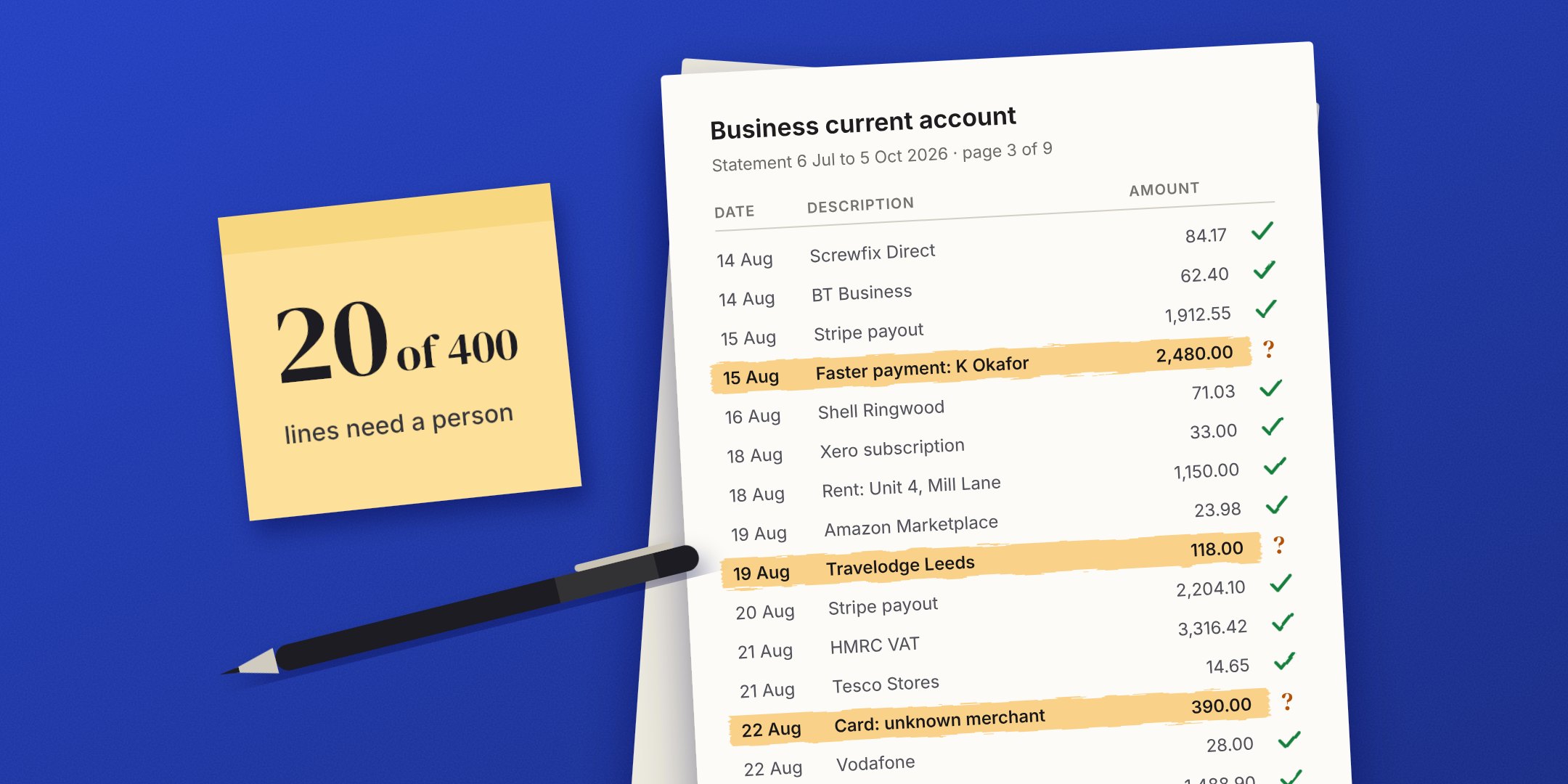
Take a hypothetical practice getting ready for Making Tax Digital. Since April, sole traders and landlords with qualifying income over £50,000 have had to send HMRC quarterly updates, and the second one is due on 7 November. A bookkeeper pastes a client's bank export into a chatbot and asks it to categorize the transactions. The output looks tidy. Then a senior colleague goes through all 400 lines, because nothing tells them which 20 the model guessed at.
The model probably got most of it right. The trouble is that nobody can tell which parts, so all of it gets checked.
Building the checking into the work
Checking doesn't go away as a firm gets further along with AI. What changes is that it gets decided in advance: what gets checked, by whom, and against what.
In a system built around the workflow, that looks like this:
- The agent works from your records. It categorizes this quarter's transactions against how the same client's transactions were categorized last year, and against the rules your team already follows.
- It says when it's unsure. Lines that match a known pattern are handled. Lines that don't, such as a new payee or an unusual amount, go to a person with the reason attached.
- The review queue is where the person's time goes. The bookkeeper works through the 20 flagged lines instead of re-reading 400. Their decisions feed back in, so next quarter there are fewer.
- Changes get tested before they go live. When the model, the instructions or the rules change, the system runs against past cases where you already know the right answer, and you see the accuracy before anything switches over.
The same approach works for client intake, engagement letters, matter updates and invoice matching. A person still signs off on anything that matters. They stop proofreading the parts that were never in doubt.
Is checking eating your time savings?
Spend one week keeping notes. For each task your team uses AI for, write down:
- Who checks the output, and how long it takes them.
- Whether they check every item or only some, and how they choose.
- What they compare it against: the client file, last year's numbers, their own memory.
- How often they find a mistake that matters.
If the second answer is "everything" and the fourth is "rarely," you're paying a senior person to confirm work that was mostly right. That task is a good one to build properly. The checking rules already exist in someone's head, and writing them down is most of the design.
If the fourth answer is "often," the AI is missing context it needs, and checking harder won't fix that. It needs access to the records your team checks against.
Is someone at your firm spending their mornings checking AI output? Book a 30-minute call and we'll go through one of those tasks with you: where the time goes, what a review queue for it would look like, and whether it's the right thing to build first. If it is, you'll get a fixed-fee proposal within a week.