
The Work That Wasn't Worth Automating a Year Ago
AI models got cheaper and more capable again this year. For an operating business, that moves the checking, reading, and chasing nobody has time for into the worth-automating column.
Cloudfinch Team
Oct 6, 2026
Most businesses have a list of work they know they should do and don't: checking every invoice line against its purchase order, reading every return reason, comparing every delivery with the window the customer was promised. Teams sample it, skim it, or leave it for month-end, because doing it for every record would take more hours than it saves.
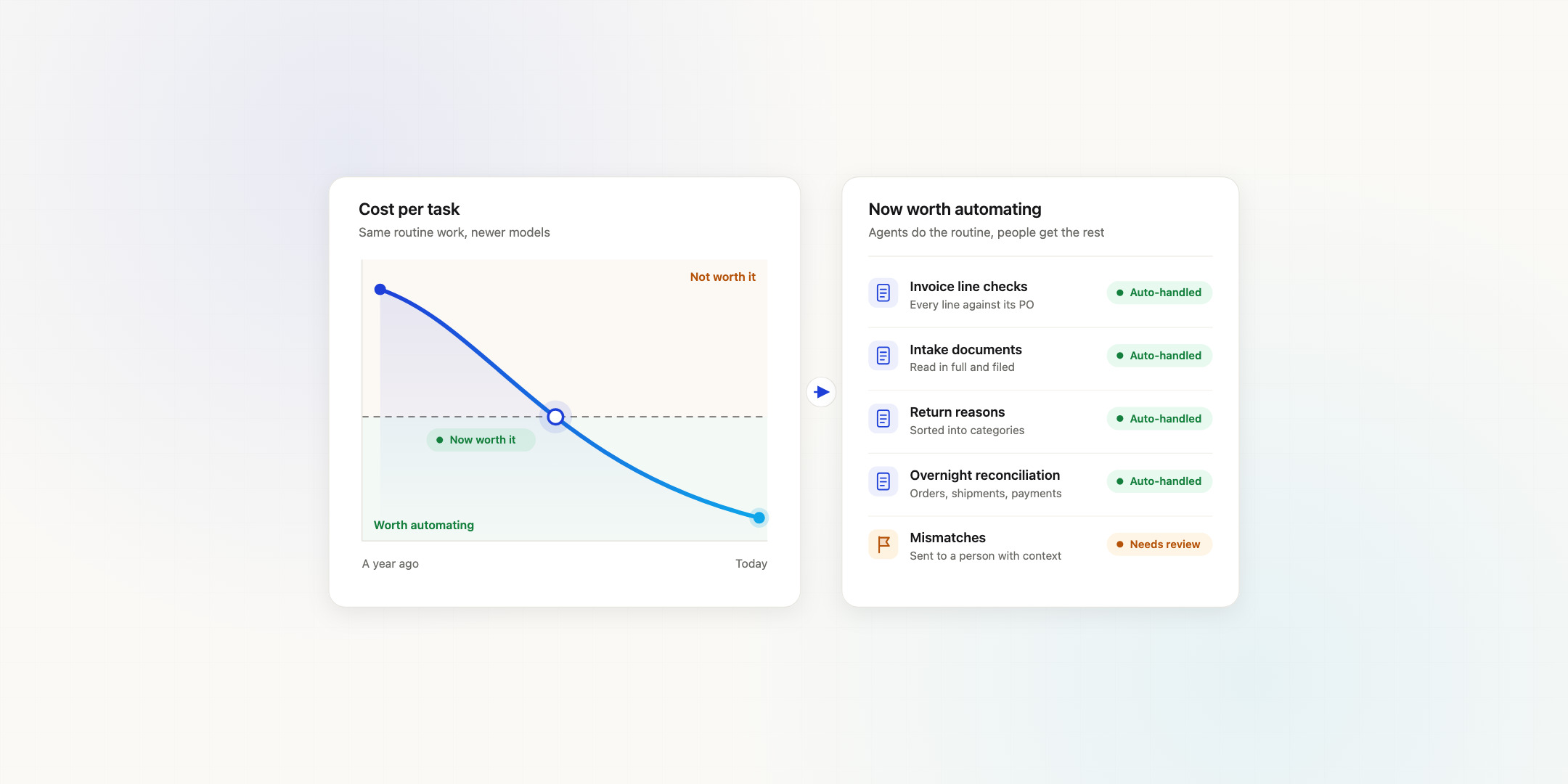
A year ago, handing that list to AI often didn't pay either. The models could do parts of it, but the cost per record, the size of the files, and the length of the tasks got in the way.
Over the past twelve months the AI labs have moved all three, and a lot of that list is now worth automating.
What changed in twelve months
The releases came quickly this year. Five changes matter most for operating businesses.
What a routine task costs now
Anthropic's documentation includes a worked example: handling 10,000 support conversations, averaging about 3,700 tokens each, with Claude Haiku 4.5 costs about $37 in model fees (pricing docs). Work that can wait a few hours runs through the Batch API at half price, and repeated instructions served from the prompt cache cost a tenth of the normal input rate.
For most routine work, the model bill is now a small line next to the hours the work used to take.
The costs that remain are the ones that were always there: connecting your systems, cleaning the data the work depends on, and deciding who reviews what. They still deserve a careful plan, and they are where most of the effort in a good build goes.
Work that just crossed the line
None of these ideas are new. What has changed is that they pay at the volumes of a 10 to 500 person company.
Match the model to the step
Cheaper models change how a system should be designed. A well-built workflow uses different models for different steps: a small, fast model to classify and extract, a mid-tier model to draft and reconcile, and the top model for the cases that need judgment. Anything the agent is unsure about goes to a person, with the context attached.
This is how we design for a predictable monthly run cost. The routine bulk of the traffic goes to the cheaper models, caching and batching handle the repeats, and every proposal includes a projected monthly bill.
Every release is an upgrade you can take
The labs now ship meaningful improvements every few months. Anthropic says Sonnet 5.5 runs more than 30% faster than Sonnet 5 and costs up to 30% less for most work, at the same per-token price.
A system built to take these upgrades gets cheaper and better over time. Taking one is routine work, but it has to be done carefully: run the new model against your own past cases, compare accuracy, cost, and speed, and switch when it wins.
That testing and upgrading is a core part of what we do in Operate, so the improvements the labs ship reach your system without your team having to track every release.
Find your list
You can find your own candidates in an afternoon:
The first one shows you what the models can do on your data, and the rest of the list gets easier to prioritize from there.
Have a list of work that was never worth doing by hand? Book a 30-minute call and we'll go through it with you: which items today's models handle well, what the monthly run cost would look like, and which one to put into production first. If it makes sense to work together, you'll get a fixed-fee proposal within a week.