
Your Own Team, a Big Consultancy, or a Specialist: How Growing Businesses Get AI Into Production
Getting AI to do real work in a business takes five steps and a mix of skills most growing companies don't have in-house. Here are the three ways to get them, what each one involves, and what to ask for whichever you choose.
Cloudfinch Team
Oct 26, 2026
Most growing businesses already pay for AI tools. Staff use a chat assistant to draft emails and summarize documents, and it helps. The work that would change the business is different: reading every invoice and matching it to a purchase order, filing every intake document, answering routine customer questions from order data, re-planning the day when a job runs late.
That work needs a system built around how the business runs, and building one takes skills most companies of 10 to 500 people don't have on staff.
What getting AI into production involves
Whoever does the work, it comes down to five steps.
- Find the right first use. Work out which workflow would pay back, and which would make a good demo and then stall.
- Build on real data. Prototype against the business's own records and documents, with all their gaps and odd formats.
- Measure before trusting it. Set up evaluations that test the system against real past cases, so everyone can see when it is good enough and when it starts to slip.
- Put it into production. Connect it to the systems people already use, with a clear path for the cases it can't handle.
- Keep it running. Watch how it's used, fix what people work around, and keep it current as models and tools change.
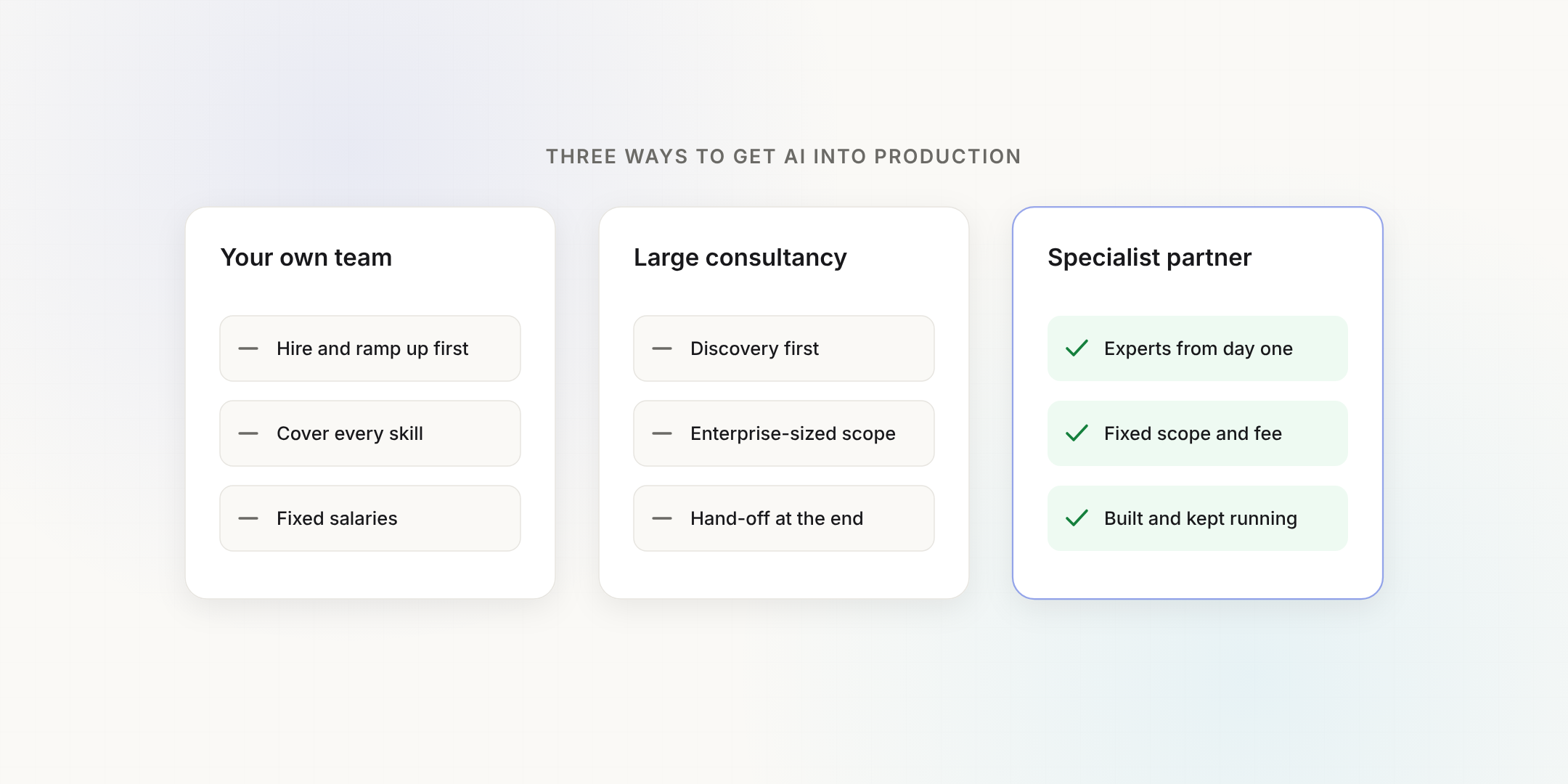
The steps call for product judgment, software engineering, data work, evaluation, and ongoing operations. There are three common ways to get them.
Option 1: Build your own team
Hiring gives you people who know your business deeply and stay with it. It's the right answer for companies where AI is the product, or where there is enough work to keep a team busy for years.
For most growing businesses it is a slow and expensive start:
- A search and ramp-up period comes first. Nothing ships while you hire, and the first months go to learning the business.
- One hire rarely covers every skill. Someone strong at building models may never have run a system in production, and the reverse.
- The cost is fixed. Senior salaries continue whether or not there is a project that month.
- Knowledge walks out the door. When the person who built the system leaves, the understanding of how it works often leaves too.
Option 2: Bring in a large consultancy
Large consultancies bring broad expertise, established methods, and the capacity to run big programs across many teams at once. For an enterprise transformation, that scale is the point.
For a growing business, the fit is harder:
- Engagements are sized for enterprise budgets. Discovery phases, workshops, and strategy work often come before anything is built.
- The team changes over time. The people who scope the work are often not the people who build it.
- There is a hand-off at the end. Someone else, usually your own team, has to run what was built.
Option 3: Work with a specialist partner
A specialist builds systems like yours all the time, for businesses your size. The model works when the same people take the system from the first conversation to production and keep it running afterwards.
What it gives a growing business:
- Experience on day one. People who have built and run these systems before, with no hiring period.
- A fixed scope and price. One workflow, agreed up front, instead of a headcount commitment or an open-ended program.
- Speed. A first system in production in weeks, so you learn what AI can do on your own data quickly.
- Continuity. The people who built it monitor it, upgrade it, and improve it as your business changes.
What to ask for, whichever route you take
- Start with one workflow. Pick work that happens every day, follows rules most of the time, and takes hours your people would rather spend elsewhere: invoice matching, client intake, support replies from order data, scheduling, or weekly reporting.
- Ask for production, not a pilot. Ask what will be running on your data, used by your team, within four to six weeks.
- Insist on evaluations and a review queue. You should be able to see what the system handled, what it passed to a person, and how accurate it is on your own cases.
- Own the code and the runbooks. The system should live in your accounts, with documentation that lets any capable engineer pick it up.
- Plan for the year after launch. Agree who upgrades models, watches quality, and feeds your team's corrections back in.
Where Cloudfinch fits
This is the work we do for growing businesses. We find the workflow worth automating, build the AI that handles it, put it into production in about four weeks at a fixed fee, and keep it running after launch. You own everything we build.
Have a workflow that slows your business down? See how the first system works, or book a 30-minute call and we'll go through it with you. If it makes sense to work together, you'll get a fixed-fee proposal within a week.