
Companies House ID Checks Are Now a Standing Job for Your Practice
The transition year for Companies House identity verification is ending. For practices that file for clients, the chasing for personal codes now runs all year, and it can run as a system.
Cloudfinch Team
Nov 17, 2026
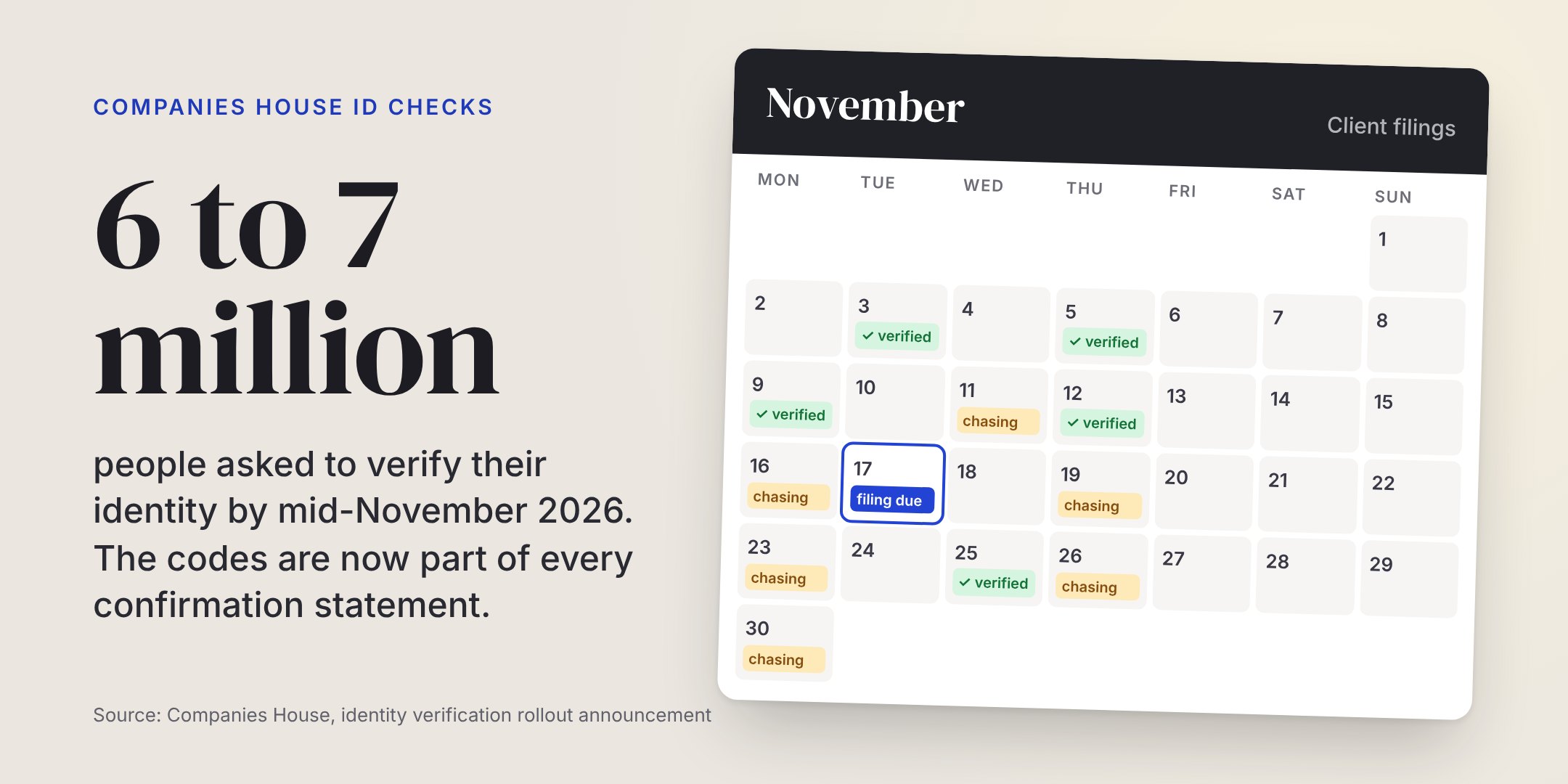
Companies House made identity verification a legal requirement for company directors and people with significant control (PSCs) on November 18, 2025. When it announced the rollout, it estimated that 6 to 7 million people would need to verify by mid-November 2026. Existing directors had a 12-month transition period and confirm their verification with the company's next confirmation statement. That year ends this week.
For a practice that files confirmation statements for its clients, the past twelve months involved a lot of chasing. Someone asked each director to verify through GOV.UK One Login or an authorized provider, waited for the personal code, and held the filing until every code was in.
The checks keep coming
The Companies House guidance sets out when each person gives their code:
- A director gives their personal code with the company's next confirmation statement, for every company they direct.
- A new company needs each director's code in its registration filing.
- A PSC who isn't a director has a 14-day window that starts in the first 14 days of their birth month.
- Someone who is both a director and a PSC of the same company gives the code separately for each role, with the PSC code due within 14 days of the confirmation statement date.
The guidance also says verification for other roles, including people who file on a company's behalf, will be introduced later.
So every client company now has its own calendar of dates, and most of those dates depend on someone outside the practice acting first. Each step is simple. Most of them involve waiting for a reply, and the hours go on remembering who to chase and when.
The same job, run as a system
Take a hypothetical practice that files confirmation statements for a few hundred client companies. The routine part is the same for every client: work out who needs to give a code and by when, ask for it, chase it, confirm it has been given, and file.
An agent can run that cycle from the practice's own client records. It builds the list of directors and PSCs for each company with their due dates, sends each person a plain request with the link to verify, follows up on a schedule, and marks each person as done when their code comes back. When a filing is ready, someone at the practice reviews it and files. Anyone who hasn't replied, or whose details don't match the register, goes to a person with the history attached.
The partner sees one list: which filings are ready, which are waiting on a client, and which need someone to pick up the phone. The rules are the practice's own, and the system follows them the same way every month.
A ten-minute check
Pick ten client companies with a confirmation statement due in the next three months. For each one, write down:
- Who needs to give a personal code, as a director or a PSC.
- When each code is due.
- Whether you already know they have verified.
If filling that in meant searching through emails and the register, the job is running from people's memory. That's the part to hand to a system.
Want to see how this would run at your practice? Book a 30-minute call and we'll go through the job with you: where the chasing happens today, which steps an agent could run with your team reviewing, and whether it's the right thing to build first. If it is, you'll get a fixed-fee proposal within a week.