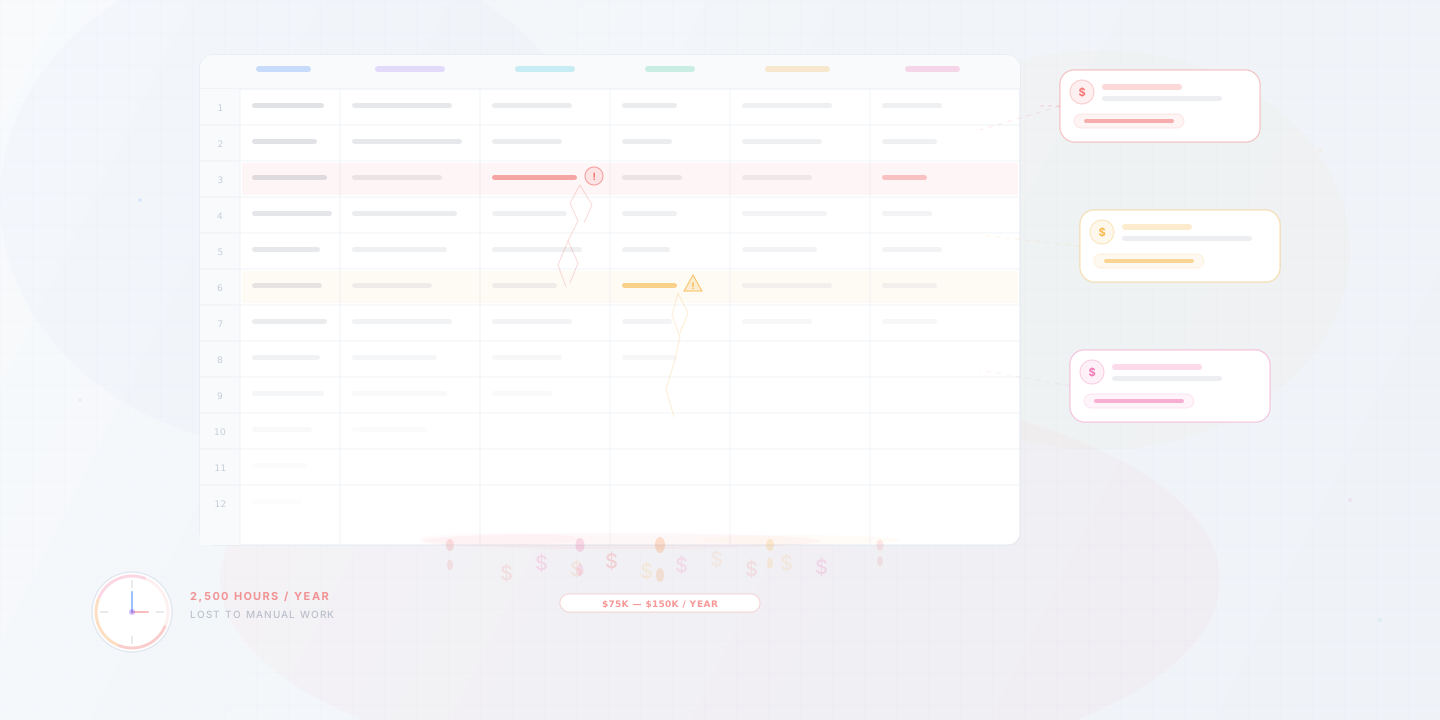
The Hidden Costs of Manual Work in 2026

Feb 4, 2026

Nobody wakes up excited to copy data from one spreadsheet to another. Nobody dreams of spending their Tuesday afternoon chasing down status updates from five different people. And yet, here we are in 2026, and a shocking amount of business still runs on exactly this kind of manual busywork.

The weird thing is, most business owners know this is a problem. They can feel it. The nagging sense that their team is busy but not productive. The frustration when a simple task takes three days because it got stuck in someone's inbox. The slow realization that they're paying skilled people to do work that doesn't actually require skill.

But here's what they don't see: the real cost of all this manual work. And it's significantly higher than you think.

The math that nobody does

Let's start with the obvious: time equals money. But most people dramatically underestimate how much time manual processes actually consume.

Consider something as mundane as weekly status reporting. A team of eight people each spends 20 minutes writing updates, someone spends 45 minutes compiling them, and a manager spends 30 minutes reading and responding. That's roughly 4 hours of human effort, every single week, just to answer the question "what's everyone working on?"

Over a year, that's 200+ hours. At an average fully-loaded cost of $75 per hour (salary, benefits, overhead), you're looking at $15,000 annually. For status updates.

Now multiply that across every manual process in your business: invoice creation, customer follow-ups, data entry, report generation, employee onboarding paperwork, vendor coordination. The numbers get uncomfortable fast.

But the time cost is actually the least expensive part.

The errors you don't notice (until you do)

Manual work comes with manual errors. This isn't a criticism of your team—it's just math. Humans make mistakes at a predictable rate, especially when doing repetitive tasks that don't engage their brains.

A data entry error rate of 1% sounds acceptable until you realize what that means at scale. If your team enters 500 records a month, that's 5 errors. Some of those errors are harmless. Some of them mean a customer gets the wrong order, an invoice goes to the wrong amount, or a compliance report contains incorrect data.

The real cost isn't the error itself—it's everything that happens after. Someone has to notice the problem. Someone has to investigate. Someone has to fix it and communicate the fix to everyone affected. A 30-second data entry mistake can easily create 3 hours of cleanup work and one very unhappy customer.

And those are the errors you catch. The ones you don't catch just sit there, quietly compounding until they become a real problem.

Your best people are doing your worst work

Here's what really keeps me up at night when I talk to small business owners: the opportunity cost.

You hired smart, capable people. You're paying them good salaries. And then you ask them to spend a significant chunk of their week on tasks that don't require intelligence, creativity, or judgment.

Your operations manager, the one who's great at solving complex logistics problems, spends every Monday morning manually updating inventory spreadsheets. Your sales lead, who has a gift for reading customers and closing deals, spends two hours daily on CRM data entry. Your finance person, who could be analyzing cash flow patterns and finding savings, is buried in manual invoice reconciliation.

Every hour your best people spend on low-value repetitive work is an hour they're not spending on high-value strategic work. And unlike the time cost, this opportunity cost doesn't show up on any spreadsheet. It just silently limits how fast your business can grow.

The speed tax

There's another hidden cost that's harder to quantify but equally real: the speed at which your business can move.

Manual processes create bottlenecks. When a task requires a human to do something, it has to wait for that human to be available, focused, and aware that the task needs doing. This introduces delays at every stage.

A quote request that could be answered in minutes takes a day because someone has to manually look up pricing and availability. A customer complaint that should be resolved immediately waits until the right person checks their email. An internal approval that should take seconds takes a week because it's sitting in someone's inbox behind 50 other items.

In 2026, your competitors are moving fast. If your business is stuck in manual-process molasses, you're not just inefficient—you're losing deals to companies that can respond faster, deliver sooner, and adapt quicker.

The speed tax is especially brutal for small businesses, where agility is supposed to be your advantage over larger competitors. If your processes are slower than theirs, you've given up the one edge you had.

The morale problem nobody talks about

Ask your team members, honestly, how they feel about the repetitive manual tasks in their jobs. You'll hear some version of: "It's fine, it's just part of the job."

What they're not telling you: it's slowly killing their motivation.

People want to do meaningful work. They want to solve problems, create things, help customers, make a difference. They don't want to be human robots, copying data from system A to system B because nobody has automated it yet.

The best employees, the ones you most want to keep, are also the ones most frustrated by pointless busywork. They know their time could be better spent. They can see that other companies have figured this out. And when a recruiter calls with an opportunity that promises "modern systems" and "automated workflows," they're going to listen.

The cost of losing good people to automation-envy? Easily 6-12 months of salary when you factor in recruiting, onboarding, and lost productivity. For a $70,000/year employee, that's $35,000 to $70,000 walking out the door. And it's completely preventable.

What this actually looks like (real examples)

Let me get specific, because vague advice is useless.

The invoice chase: One company we talked to had an accounts receivable person who spent 15 hours a week manually tracking down late payments. Calling customers, sending reminder emails, updating spreadsheets, escalating to managers. Fifteen hours. Every week. The automation that fixed this cost less than one month of that person's time, and now those 15 hours go toward actually improving customer relationships instead of chasing them for money.

The onboarding maze: Another business had a 47-step employee onboarding process, all manual. IT ticket for laptop, HR forms for benefits, manager meeting for role clarity, facilities request for desk setup, security access forms, training schedule coordination. New hires spent their first week filling out paperwork instead of learning their jobs, and the HR team dreaded every new hire because of the coordination nightmare. One automated workflow replaced the chaos with a smooth sequence that just... happens.

The reporting rabbit hole: A team was spending every Friday afternoon building a weekly report. Pulling data from three systems, reformatting it, creating charts, writing summaries, emailing it to leadership. Four hours of skilled employee time, every single week, for a report that leadership skimmed in 5 minutes. Now a dashboard updates automatically, and Fridays are for actual work.

These aren't exotic enterprise problems. They're the everyday friction that accumulates in every growing business.

How to find your hidden costs

If you're reading this and thinking "okay, but where do I even start?"—here's a simple exercise.

For one week, have your team track every time they do something that:

  • Involves copying data from one place to another

  • Requires waiting for someone else before they can proceed

  • Feels like "busy work" that doesn't require their expertise

  • Has to be done the same way, every time, without variation

You'll quickly build a list. Some items will be small (5 minutes here and there). Some will be surprisingly large (entire days lost to a single process).

Prioritize by frequency times time. Something that takes 10 minutes but happens daily is costing you more than something that takes an hour but happens monthly.

Then ask: does this actually need a human? Not "has this always been done by a human" but "is human judgment, creativity, or relationship genuinely required here?"

For most items on that list, the answer is no.

The ROI is usually embarrassing

I say embarrassing because when businesses finally automate their painful manual processes, they often can't believe they waited so long.

The payback period on most operational automation is measured in weeks or months, not years. A $10,000 investment that saves 10 hours a week pays for itself in under 4 months, and then keeps paying forever.

More importantly, the benefits compound. Faster processes mean faster revenue. Fewer errors mean happier customers. Less busywork means more engaged employees. Better data means smarter decisions.

The hidden cost of manual work isn't just what you're spending today. It's all the growth you're leaving on the table by keeping your best people stuck in operational quicksand.

If you want to stop the bleeding

We help small and medium-sized businesses identify and eliminate the manual work that's holding them back. Not with massive IT projects or enterprise software—with targeted, practical automation that solves real problems.

If you've read this far and you're doing the mental math on your own hidden costs, that's a good sign. It means you're ready to have an honest conversation about where your business is leaking time, money, and talent.

No pressure, no pitch. Just a practical discussion about what's possible and what would actually make a difference for your specific situation.

👉 Book a free operations review

Insights & Resources

Stay ahead with our latest insights on software, AI and business growth

Jan 27, 2026

7 Operational Bottlenecks Quietly Killing SMB Revenue (And How to Fix Them in 90 Days)

Jan 27, 2026

7 Operational Bottlenecks Quietly Killing SMB Revenue (And How to Fix Them in 90 Days)

Jan 27, 2026

7 Operational Bottlenecks Quietly Killing SMB Revenue (And How to Fix Them in 90 Days)

Jan 7, 2026

AI for Small Businesses: Stop Overthinking It

Jan 7, 2026

AI for Small Businesses: Stop Overthinking It

Jan 7, 2026

AI for Small Businesses: Stop Overthinking It

Dec 17, 2025

AI Adoption Roadmap for SMBs | Practical Guide to AI Implementation

Dec 17, 2025

AI Adoption Roadmap for SMBs | Practical Guide to AI Implementation

Dec 17, 2025

AI Adoption Roadmap for SMBs | Practical Guide to AI Implementation

Ready to transform your business with custom software & AI?

Let’s build your success story

Modernise legacy systems, automate workflows and launch new products with a partner who specialises in your growth.

Stay Connected with Cloudfinch

We help businesses launch products faster, harness AI and scale confidently. From idea to MVP and beyond, our agile teams deliver custom software in weeks, not months.

Copyright: © 2025 Cloudfinch. All Rights Reserved.

Ready to transform your business with custom software & AI?

Let’s build your success story

Modernise legacy systems, automate workflows and launch new products with a partner who specialises in your growth.

Stay Connected with Cloudfinch

We help businesses launch products faster, harness AI and scale confidently. From idea to MVP and beyond, our agile teams deliver custom software in weeks, not months.

Copyright: © 2025 Cloudfinch. All Rights Reserved.

Ready to transform your business with custom software & AI?

Let’s build your success story

Modernise legacy systems, automate workflows and launch new products with a partner who specialises in your growth.

Stay Connected with Cloudfinch

We help businesses launch products faster, harness AI and scale confidently. From idea to MVP and beyond, our agile teams deliver custom software in weeks, not months.

Copyright: © 2025 Cloudfinch. All Rights Reserved.