Should You Build Custom AI Software or Buy SaaS? A Practical Guide for SMBs
The wrong choice between custom software and SaaS costs SMBs twice — once in money, again in operational drag. Here's a practical framework for deciding when to buy, when to build, and when to do both.
Cloudfinch Team
Mar 18, 2026
Most SMBs don't fail at adopting technology. They fail at choosing the right *kind* of technology.
Buy a SaaS tool too quickly, and your team spends months forcing their workflow into someone else's product. Build custom too early, and you burn budget on complexity you didn't need yet. Either way, the cost isn't just the software — it's the operational drag that follows.
The right answer is rarely "always buy" or "always build." It depends on your workflows, your data, your growth plans, and how much of your operations actually make you different from everyone else.
The short answer
Buy SaaS when your process is common, your team can adapt to standard workflows, and speed matters more than differentiation.
Build custom AI software when your business depends on unique workflows, disconnected systems, complex manual handoffs, or domain-specific logic that generic tools can't handle well.
A lot of growing businesses end up somewhere in the middle: they start with SaaS, then hit a ceiling. That's when custom software starts creating real ROI.
When SaaS is the better choice
Off-the-shelf software wins when your needs are standard and your edge comes from somewhere other than operations.
The rule is simple: buy SaaS if you can adapt your business to the software without hurting service quality, margins, or team productivity.
When custom software is the better choice
Custom software starts winning when your business is paying a hidden tax every day to work around rigid tools.
Your team lives in spreadsheets and copy-paste
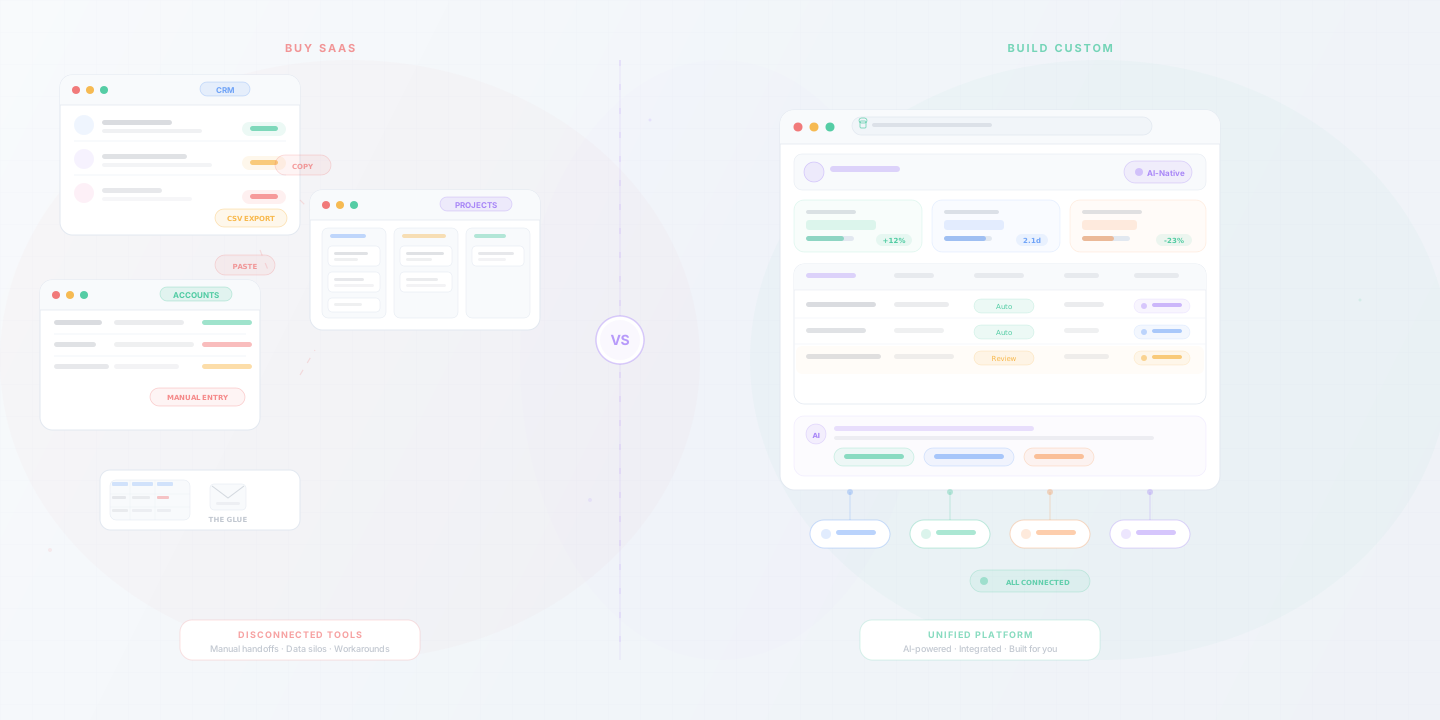
This is usually the clearest signal. If people are manually moving data between your CRM, ERP, accounting system, operations tools, approval chains, and customer communication — you don't have a software stack. You have a collection of disconnected tasks.
That's exactly where custom automation and AI-native workflows become valuable.
Your process is part of your competitive advantage
If your business runs on specialised approvals, custom pricing logic, document-heavy operations, or business-specific decision rules, a generic tool will eventually force compromises that erode what makes you different.
You need AI to work on your actual data
Many tools advertise "AI features," but most are generic layers on top of generic products. Custom AI makes more sense when you need document classification based on your business rules, natural language search across internal systems, predictive dashboards built around your metrics, or intelligent routing based on your own operational data.
You've outgrown software patchwork
A common pattern: start with simple tools, add more as you grow, hire people to bridge the gaps manually, then realise you're paying salaries to compensate for bad systems. At that point, custom software isn't a luxury — it's an efficiency decision.
The real cost comparison
A lot of teams compare custom software to SaaS using only subscription pricing. That's the wrong comparison.
The real cost of SaaS includes:
The real cost of custom software includes:
The smarter question isn't "which is cheaper?" — it's which option gives us the lowest operational drag over the next 12–24 months?
For most SMBs, SaaS is cheaper at the start. For growing SMBs with process complexity affecting revenue, margin, or customer experience, custom becomes cheaper faster than you'd expect.
A simple decision framework
Use this five-question test to guide your thinking.
Buy SaaS if you answer "yes" to most of these:
Build custom if you answer "yes" to most of these:
The hybrid approach most SMBs should actually take
In practice, the best path is often neither extreme. It's hybrid.
That means keeping the SaaS tools that work, integrating the systems that matter, custom-building the workflow layer where your business is unique, and adding AI where it removes real friction.
For example, instead of replacing everything, you might:
This is often the highest-ROI path because it avoids unnecessary rebuilds while removing the most expensive bottlenecks.
Signs you're ready to talk to a custom software partner
You're probably ready if:
At that point, the issue usually isn't "we need more tools." It's "we need better architecture."
What the right partner should help you do
A good custom software partner should not start by pitching features. They should help you answer:
The goal isn't to build the biggest system possible. It's to build the smallest system that removes the biggest drag on your business.
The bottom line
Buy SaaS when the problem is common. Build custom when the workflow is strategic.
If your business is growing but your operations still depend on spreadsheets, workarounds, disconnected tools, and manual coordination, custom AI software can create a real advantage — not because it sounds innovative, but because it makes the business run better.
The best systems don't just digitise work. They reduce friction, connect decisions, and get smarter over time.
Schedule a free consultation and we'll help you identify which workflows to keep in SaaS, which bottlenecks are worth custom-building, and where AI can deliver measurable ROI fastest.